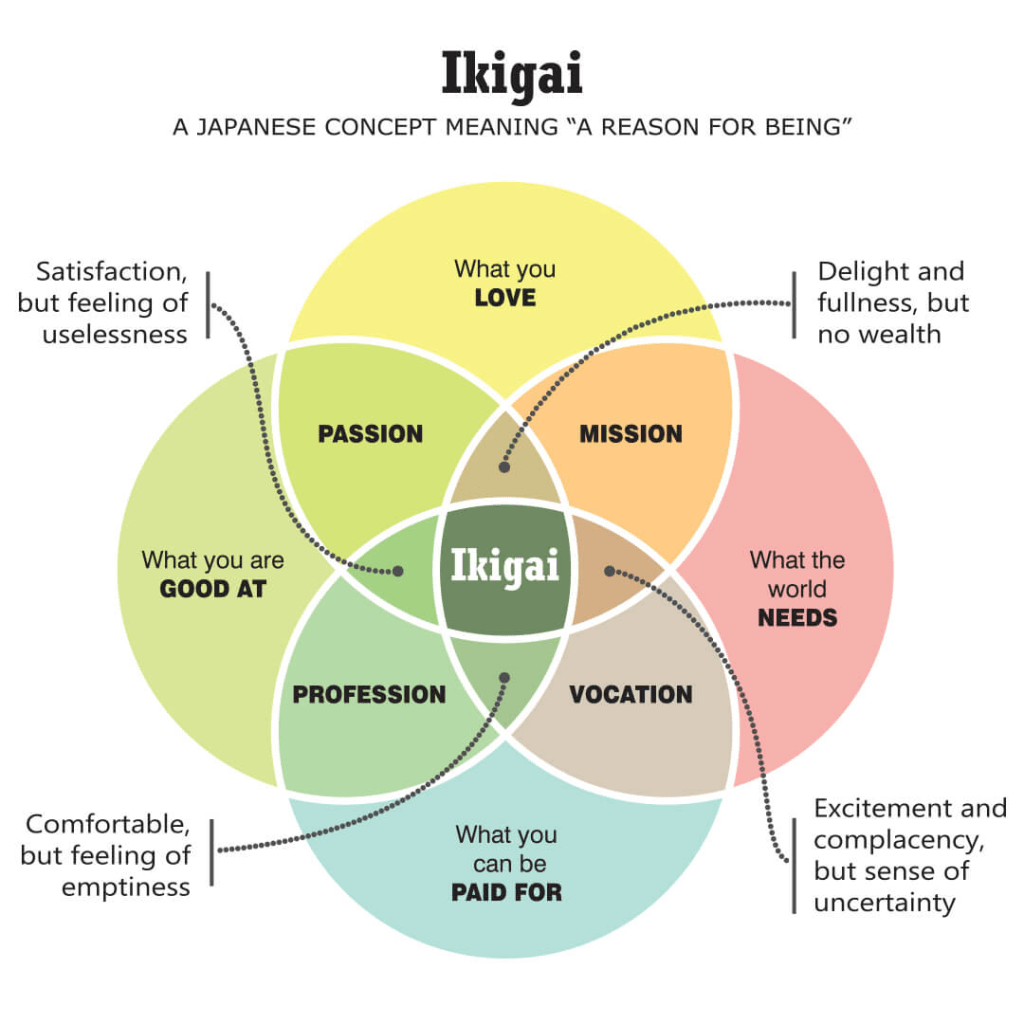
At the Jerusalem Academy for Music and Dance I have a class called “The Compass and the Map.” If you know anything about me, you know that I loved it in advance just based on the name alone. Also the course revolves around Ikigai and the four pillars model: what you love, what you are good at, what the world needs, what you can get paid for. I also loved the concept of Ikigai when I discovered it. It’s partially why I became a teacher. But now, was to find my Ikigai as a dancer. This was a different ballgame altogether.
One of our assignments was to write our bio. Not just a regular bio, a bio inspired by another artist that breaks the mold of what’s included in the “life events” one is normally asked to share for employment; a bio that gives life to our personality and who we are as an artist. Here is mine. Should I trade it for the “About Me” page I currently have?


שלב המצפן, שנה ב’ תשפ”ו
Rainbow Peacock a month ago שלב המצפן, שנה ב’ תשפ”ו
Shoshana Sarah | שושנה שרה
Legend has it that Shoshana was in ballet classes when she was five years old (along with violin, according to the Suzuki Method), but it didn’t work out because either:
(a) she was put out for talking too much, or
(b) she didn’t want to stay because she wasn’t allowed to chat.
She has no recollection of these events, but either version checks out in light of the fact that running her mouth became one of her main tools. Today she dances and dances with words. This is a non-linear story – it cannot be told in proper chronological order – though the signs have always been lighting the way.
She had a bad habit of choosing things for the wrong reasons: like playing the French horn in elementary school because she was obsessed with the French language and all things French or studying international relations for her first BA and MA because she loves travel.
In high school, she recited Maya Angelou’s poems and danced as a flag girl with the marching band, so she could stay close to musicians if she weren’t going to be one (the story of how her French horn was lost is a mystery). It was here, dancing with the marching band, that she discovered her groove. But it would take many years for her to know what this means.
In 2010, she discovered one day that she loves teaching entirely by accident, so she started teaching English as a foreign language, and has been a teacher in some capacity – from EFL to academic writing, spoken word to creative writing workshops– ever since.
At a covertly “woo-woo” workshop in Silver Springs in 2011, she realized she must dance. She’d feared it was too late, but time would unravel a long journey in which she would one day form her mouth to call herself a dancer. She had an insatiable thirst and tried everything from hip hop to modern, Broadway to Bollywood, salsa to belly dancing. Belly dancing made her feel “my body was made for this.” By 2016, she’d fallen deeply in love with belly dancing, Romani and Turkish rhythms. She played the zills (sagatim), danced with silk scarves, created her first dance piece “Never Catch Me,” and recited poetry on a dance stage. Someone told her, “You were born to dance.”
By 2012, she finally figured out that she could mix the things that she loves and founded Poets of Babel, a multilingual poetry club for those who love the musicality of the spoken word and for weirdos like her who love poetry even if they don’t understand it. Apparently, there are plenty like her, as it celebrates 14 years.
Later, she joined the early days of Poetry Slam Israel and was the only English speaker on a Hebrew stage. Often, she never knew whether they didn’t like her poetry, or didn’t understand it. But her “4 Questions I’m Tired of Answering” poem earned some notoriety and was the only English/multilingual poem published in the Poetry Slam anthology. Since she wanted to be “a serious poet,” she got a second master’s in Creative Writing with a specialization in Poetry from Bar Ilan University. Then she was able to form her mouth to call herself a poet. She inadvertently fell in love another genre on the way – the lyric essay, a type of poetic non-linear prose – and can’t stop talking about it to anyone who’d listen. She has since published more lyric essays than poems but still identifies as a poet.
Dreaming of mixing spoken word and eastern dance, she was instructed to find Orly Portal. She saw Swariya, a fusion of Gnawa and the godfather of spoken word Gil Scott-Heron and wanted to jump on the stage. Her soul was on fire. She saw home. For a few years, it was too far for her to reach, but in 2019, when Orly opened her Swariya repertoire course, she came home in her pelvis and in Gnawa rhythms. “It’s your rhythm,” Orly had told her. With sagatim and krakebs, she’d become the musician again, a percussionist, and played rhythms with her body. She’d found her place at the seam of things: singing, dancing, playing music all at once.
She left for two years to become a homeroom teacher at an anthroposophy school. It was equal parts beautiful and harrowing. But when she came back to dancing, she swore she’d never leave her body behind again. This is a promise she kept. Since then, she has chosen things for the right reasons: Feldenkrais in 2022, contact improvisation in 2024, the Orly Portal Method teaching certification in 2024, HaKvutza dance school in 2025, and now (2026) the Jerusalem Academy of Music and Dance in the Movement Focus.
Since 2023 and 2024, respectively, she has been teaching creative writing workshops and the Orly Portal Method. In 2026, her piece “Kaddish for Daddy” debuted and was the collection of all of her parts: poetry, dance, singing, and creating a space to invite you in. Her hybrid lyric memoir Not on the Map is forthcoming. Discover more of her multidisciplinary behavior, including collages and voiceover work, at shoshanasarah.com
Facebook: www.facebook.com/shoshanasarahk/
Instagram: www.instagram.com/shoshanathedancingpoet/


