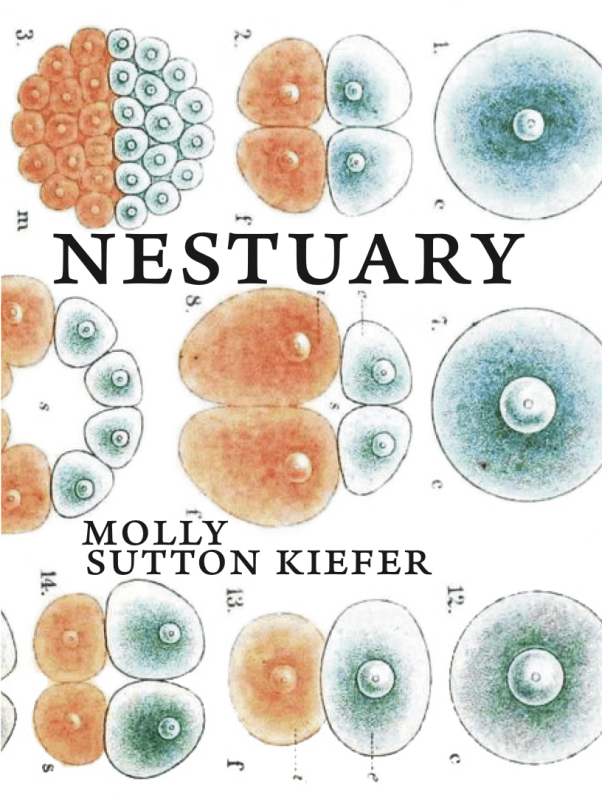
Many moons ago, I wrote a book review, my very first one, that was published in Entropy Magazine. I searched for it recently and found that it had disappeared, the link no longer functional. Later, I discovered the journal shut down in 2021 and deleted its website and archives. I’d love to keep this review alive. I found the book fascinating and I’m proud of my first book review that got published on the first try (a rare feat). Also, it’s wild historically to see this was written when I was unfamiliar with lyric essay and today it is my absolute favorite genre, on par with poetry for me. Here it is:
Nestuary by Molly Sutton Kiefer
Ricochet Editions, 2014
Nestuary, Molly Sutton Kiefer’s first full-length lyric essay, is the story of her rites of passage into motherhood that begin with infertility treatment. Kiefer relieves us of worry in the first chapter, writing: “I can tell you this (now): This story has a happy ending.” She details difficult pregnancies, Caesareans, and the “gorgeous time after” with her daughter and then son. Characteristic of the lyric essay form, Kiefer employs verse, memoir, and reportage to weave her narrative of the body with mythology, etymology, history, unusual facts, and creative definitions.
Greco-Roman mythology plays the largest part in Kiefer’s narrative of the body, primarily in reference to the Roman goddess Diana and her Greek counterpart Artemis:
The Roman goddess Diana causes me to catch my breath.
She is: the goddess of the hunt, the moon, and birthing.
She is rooted in the oak groves; her midwife is a water
nymph.
Her name is dewy on my lips.
A cult formed around Diana; women would pray to
become pregnant and once pregnant, pray for an easy
delivery.
Diana and the companions she kept were all virgins.
The myth of Diana gives Kiefer’s focus in her desire to conceive, though she recognizes the irony of a virgin goddess of birthing, evident by how the line is indented and set aside from the rest. The speaker needs to catch her breath because, as she mentions a line earlier, “In wanting this, I pit myself against myself.” This sentiment is echoed in the juxtaposition of “Clarity of intention is crucial./Clarity of intention is cruel”; she must, on the one hand, know what she wants in order to achieve it, and at the same time wanting what has been heretofore unattainable is a form of self-inflicted torture. Throughout Nestuary, Kiefer prays to Diana and other goddesses and invokes the moon, hoping for an easy (natural) delivery. But she is not restricted to the Greco-Roman tradition. She cannot afford to be. Kiefer will try anything. A Japanese Daruma—a good luck charm based on the legend of Bodhidharma, a Buddhist monk— glares at the reader, just as it glares as her, waiting, almost daring her to mark his eye to make a wish. She exudes faith in the “eerie and angry” Daruma in the form of a fierce resolve that borders on macabre—like the huntress she entreats who walks through boneyards “like a dead woman”—in order to bring forth life.
When Hercules arrives, decapitating the hydra, we wonder what the connection could possibly be. Hercules is no goddess, no patron of conception or childbirth or the domestic domain. He is a hero of men. Yet as Kiefer’s story unfolds, we understand how Hercules fits into the contemporary mythology that’s being developed. Kiefer manoeuvres through the tale of the hero’s “labor” of decapitation to “images of the headless pregnant woman”—that is “selfies” of the torso—to photoshopped “headless portraits” of women from Victorian Era gone viral on social media. We may still wonder where this bizarre association game—of laborious violence and slain hydras and headlessness—is going. However, what appears to be freakishly random falls into place. Kiefer is describing the sense of disembodiment in the pain of labor and in the subsequent C-section she endures. She prepares us for this cutting, writing, “twelve hours before it happened, a/threat in the air: Caesarean section” and then a pauses to debunk myths surrounding the origin of Caesarean and explore the etymology of the word:
For the record.
The story that Julius Caesar was born via Caesarean
section is false. C-sections were performed in Roman
times, but there is no documentation of a mother surviving
one. Instead, C-sections were only permitted when the
mother died (or was dying) during childbirth. Caesar’s
mother Aurelia is reputed to have survived her son’s birth.
It is also suspected the term is derived from the verb
caedere, which means to cut, as in cut from the womb.
In some translations, Caesarean section means emperor’s
cut, emperor incision, imperial cut, tzar cut.
There is an irony in noting the translations of a Caesarean as an “imperial cut.” For the author, it is an oxymoron. She feels a violence has been done against her and supports this with tales of Apollo, who according to one version of Greek mythology removed his son Asclepius (“and eventual god of medicine and ancient healing”) from his mother’s corpse, and Macbeth who was “from his mother’s womb/ Untimely ripp’d.” The violent experience of a Caesarean is a trauma that for many women, beyond the physical pain, leaves a sense of betrayal and shame of the failure of one’s body to give birth of its own volition as expected.
In her “transubstantiation,” Kiefer makes peace with the sounds soft c. The Caesarean that represented a violent disembodiment transforms to the “cetacea” and “caesura” she wishes to inhabit:
Cetacea: The order of marine mammals that include
dolphins, porpoises, and whales.
I believe I epitomize
lumber
at my acupuncture appointment today. My sciatic nerve
is furious, bleating out small shards of pain.
The doctor said, You must be one of those women who get
as big as a garage.
It’s an interesting image: baby-as-car,
humming until winter-warm.
But I prefer W H A L E ,
as it forgives my all-over enormity, allows me
to feel a bit peaceful, imagining myself as enclosed in
water too.
That word: obese. A hook to hang me on.
(Obeisance) (Obedient) (Obliging)
The spaces are large and wide as the whale she would rather be, as the caesura she has always loved—“I’ve always loved the caesura. I’ve loved the line-break, the/ use of white-space”—her technique holds a double meaning.
The word “failure” appears several times in Nestuary in the context of the Caesarean birth. The narrative of a Caesarean as failure may deter some readers, particularly those who have had one, such as myself, who did not find it a source of shame. This perspective could be rooted in judgment of mothers by mothers— which is a body of literature in and of itself. Another possibility is simply that every reader filters through their own experience, and if the author’s rendition does not correlate with the reader’s experience this can hinder appreciation of the text. However, perhaps Kiefer would say none of this is the point in Nestuary; she declares: “it isn’t the birth that is the hero of this story. The cause for/physical triumph is instead the nesting-in.”
I was drawn to Kiefer’s voice and compelling use of the lyric essay style and yet, though I am a poet who is also a mother, I resisted the subject of birthing and babies (and I love babies—birthing, well, I could do it again). I know that I am not alone in these conflicted feelings; Joy Katz’s “Baby Poetics” was essential to understanding this internal conflict. Kiefer employs what Katz calls an “emotional re-scaling” so that “the writing alights on many ideas and objects, including babies…and doesn’t linger anywhere for long.” Though Kiefer does tread on sentimentality when her babies appear in Nestuary, she accomplishes this great feat by throwing into the mix subjects as diverse as Julius Caesar to photos of headless women in the Victorian Era. She does all this, while beseeching Diana/Artemis, and singing hymns to Hestia, bewitched with Wiccan rituals in a wondrously pagan air, reinventing meaning.
I admit that I am new to the genre of lyric essay. For writers interested in this kaleidoscope of form, Nestuary is an adept example of how to roam through objects and ideas, tying them along the way into one narrative. For readers fascinated by etymologies and definitions, it is an estuary, where meanings composed meet unusual details to flow into a life story. For mythology enthusiasts, it is candidly a feral hymn.


